Semi-Truck and Tractor-Trailer Towing on I-25 and Northern Colorado
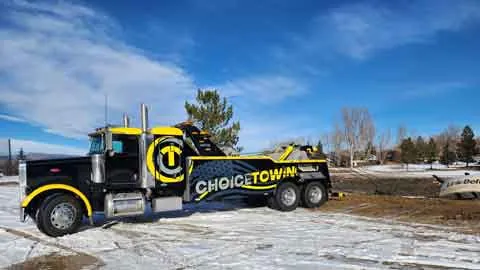
When a loaded tractor-trailer breaks down or wrecks, it is never a small problem. There is freight on a schedule, a driver trying to stay safe on a narrow shoulder, and traffic that backs up for miles if a lane is blocked. Heavy duty work is what Choice Towing & Recovery is built around. Our WreckMaster Certified heavy towing operators and fleet of heavy duty wreckers handle semi and tractor-trailer towing and recovery around the clock across Northern Colorado. Call our 24-hour heavy duty dispatch line at 970-482-0159.
The Freight Corridors We Cover
Northern Colorado sits at the crossroads of several major truck routes, and our coverage follows them:
- I-25, the main north-south freight route through Colorado, from the Wyoming line past Wellington and Fort Collins, down through Loveland, Johnstown and Berthoud.
- US-85, the truck route north from Greeley through Lucerne, Pierce, Nunn and Carr toward Cheyenne, carrying a steady flow of energy, agricultural and livestock traffic.
- US-34, connecting Greeley, Loveland and I-25, and on to the plains to the east.
- US-287, running north from Fort Collins through Laporte and Livermore toward Laramie.
Our Fort Collins location at 209 N. Link Lane sits close to I-25 and the north side of town, and our Greeley location puts heavy service close to US-34 and US-85.
Semi and Heavy Truck Services
- Tractor-trailer towing, loaded or empty
- Semi-truck (tractor) towing, bobtail or with trailer
- Semi-trailer towing for a trailer without its tractor
- Heavy truck accident recovery, including jackknifes and rollovers
- Heavy cargo recovery and load support
- Hazmat cleanup service on commercial incidents
- Heavy duty roadside
- Long-distance truck towing
- Cement mixer, dump truck and other vocational truck towing
Heavy Recovery Takes Planning
A semi that breaks down on the shoulder is one job. A loaded trailer on its side in the median, or a rig down an embankment, is a different one. Heavy recovery involves rigging calculations, the order of operations for righting a trailer, managing spilled cargo, and working with law enforcement and fire crews on traffic control. WreckMaster certification trains operators in exactly this kind of work: how to lift and pull safely with the right anchor points so the recovery does not cause more damage than the wreck did.
Effective heavy towing also takes local knowledge. A heavy wrecker with a loaded truck in tow has to stay on approved roadways and bridges. Our operators know which local roads, bridges and underpasses can take the weight and which cannot.
Winter on I-25 and the Plains
Wind is the hazard drivers from out of state underestimate. Strong crosswinds on I-25 north of Fort Collins and across the open plains east of Greeley can push an empty or lightly loaded trailer right off the road, and winter ground blizzards cut visibility to almost nothing. Ice and snow add slide-offs, stuck trucks on ramps and jackknifes. We keep dispatch running through these storms and work with the authorities on road closures. Expect longer response times in severe weather. If you are in a dangerous spot, call 911 too.
Heavy Duty Roadside Before It Becomes a Tow
Plenty of semi calls never end with a hook. Our heavy duty roadside service is dispatched from the same 24-hour line, and fixing the problem on the spot keeps your driver’s hours and your freight schedule intact. When the issue cannot be fixed roadside, the operator is already there and can switch to a tow without a second call.
Keeping Drivers and Crews Safe on Scene
A heavy truck on the shoulder of I-25 is a target for distracted drivers. Our trucks are equipped to be seen, and our operators position them to shield the work area. We back Colorado’s Slow Down, Move Over message because tow operators work in the same danger zone as police and firefighters. If you are the driver, stay off the traffic side of the rig and wait well away from the road while we work.
What Dispatch Needs From the Driver
The more we know up front, the faster and safer the job goes:
- Exact location: highway, direction, nearest mile marker or exit, or use Send Location.
- Tractor and trailer: make, model, trailer type and length.
- Load: what you are hauling, approximate weight, and any hazmat placards.
- Condition: mechanical breakdown, accident, rollover, or stuck.
- Injuries or blocked lanes: if so, call 911 first.
- Billing: company name, fleet program or motor club authorization if you have one.
Getting Freight Moving Again
For carriers and fleet managers, the goal is to get the truck back on the road or the freight back on schedule. We tow to your shop, a dealer, a truck stop or a secure location of your choice. If the tractor is down but the trailer is fine, ask about moving the trailer separately. Our business partners include FleetNet America, and commercial customers can find our credit application on our contact page.
Frequently Asked Questions
Can you tow a fully loaded tractor-trailer?
Yes. Our heavy duty wreckers handle loaded and empty tractor-trailers. Tell dispatch the load and approximate weight when you call.
Are your heavy operators certified?
Yes. Our heavy towing operators are WreckMaster Certified.
Do you handle rollovers and jackknifes?
Yes. Heavy truck accident recovery, including rollovers and jackknifed trailers, is part of our heavy recovery work.
Do you offer hazmat cleanup?
We provide hazmat cleanup service on commercial incidents. Report any hazmat placards to 911 and to dispatch right away.
Can you tow a semi long distance?
Yes. We provide long-distance truck towing. Call dispatch for details and a quote.
Call Heavy Duty Dispatch
For semi and tractor-trailer towing or recovery anywhere along I-25, US-85, US-34 and US-287, call Choice Towing & Recovery at 970-482-0159, any hour.